## Metadata
- Author: [[Greg Epstein]]
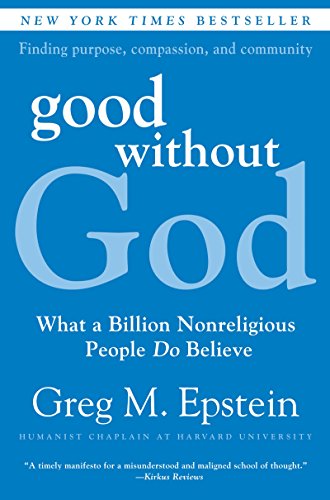
- Full Title: Good Without God
- Category: #books
## Highlights
- But sociologists have recently begun to pay more attention to the fact that some of the world’s most secular countries, such as those in Scandinavia, are among the least violent, best educated, and most likely to care for the poor.3 And as scientists are now beginning to document, though religion may have benefits for the brain, so may secularism and Humanism. Atheists meditating on positive secular images can gain the same benefits that religious people do from prayer. Strongly convinced nonbelievers may be ([Location 86](https://readwise.io/to_kindle?action=open&asin=B002SR2Q9G&location=86))
- Humanism means taking charge of the often lousy world around us and working to shape it into a better place, though we know we cannot ever finish the task. ([Location 118](https://readwise.io/to_kindle?action=open&asin=B002SR2Q9G&location=118))
- Humanism as a progressive lifestance that, without supernaturalism, affirms our ability and responsibility to lead ethical lives of personal fulfillment, aspiring to the greater good of humanity. ([Location 124](https://readwise.io/to_kindle?action=open&asin=B002SR2Q9G&location=124))
- for most, religion is not about belief in an all-seeing deity with a baritone voice and a flowing beard. It is about group identification—the community and the connections we need to live. It ([Location 129](https://readwise.io/to_kindle?action=open&asin=B002SR2Q9G&location=129))
- At the most important times of our lives—when we or our loved ones are sick and dying; when a new baby is born; when we want to affirm our love in marriage; when we want to educate our children not only about facts and dates, but also important values—we need to be part of a group. We need what, at least potentially, can be found or created in a Humanist community: a place where family, memory, ethical values, and the uplifting of the human ([Location 136](https://readwise.io/to_kindle?action=open&asin=B002SR2Q9G&location=136))
- I prefer the European term lifestance, meaning more than a philosophy but not a divine or revealed religion. ([Location 145](https://readwise.io/to_kindle?action=open&asin=B002SR2Q9G&location=145))
- said, “The enemy of Humanism is not faith—the enemy of Humanism is hate, it is fear, it is ignorance, it is the darker part of man that is in every Humanist, and every person in the world…But faith is something we have to embrace. Faith in God means believing absolutely in something, with no proof whatsoever. Faith in humanity means believing absolutely in something with a huge amount of proof to the contrary. We are the true believers.”4 ([Location 150](https://readwise.io/to_kindle?action=open&asin=B002SR2Q9G&location=150))
- concern that the new atheism is cut off from emotion, from intuition, and from a spirit of generosity toward those who see the world differently. ([Location 171](https://readwise.io/to_kindle?action=open&asin=B002SR2Q9G&location=171))
- good, not God. ([Location 185](https://readwise.io/to_kindle?action=open&asin=B002SR2Q9G&location=185))
- neither Hitler nor Nazism is ever an appropriate comeback to such arguments against religion. In carrying out the Holocaust, Hitler wrote, “I am acting in accordance with the will of the Almighty Creator: by defending myself against the Jew, I am fighting for the work of the Lord.”7 The Nazi army’s belts were inscribed “Gott mit uns!” (God is with us). ([Location 281](https://readwise.io/to_kindle?action=open&asin=B002SR2Q9G&location=281))
- The History of a Lousy Idea Indeed, no man can be good without the help of God. —Seneca, first century CE ([Location 289](https://readwise.io/to_kindle?action=open&asin=B002SR2Q9G&location=289))
- “We do not need to uplift our hands toward heaven, or to beg the keeper of a temple to let us approach his idol’s ear, as if in this way our prayers were more likely to be heard.” So far, pretty secular stuff. Seneca continued, however, with a statement that would not only have been considered radical at the time, but ([Location 305](https://readwise.io/to_kindle?action=open&asin=B002SR2Q9G&location=305))
- But “Do you believe in God?” is a totally meaningless question. The real question all people—whether secular or religious—ought to be asking themselves and one another is “What do you believe about God?” ([Location 414](https://readwise.io/to_kindle?action=open&asin=B002SR2Q9G&location=414))
- Here is the Humanist answer: we (the nonreligious, atheists, Humanists, etc.) believe that God is the most important, influential literary character human beings have ever created. ([Location 440](https://readwise.io/to_kindle?action=open&asin=B002SR2Q9G&location=440))
- “I believe in Spinoza’s God who reveals himself in the orderly harmony of what exists, not in a God who concerns himself with fates and actions of human beings.” ([Location 456](https://readwise.io/to_kindle?action=open&asin=B002SR2Q9G&location=456))
- Dewey was not exactly a pantheist, but rather called himself a “Reconstructionist”—one who reconstructs the definition of the word God in order to refer to natural human values instead of a supernatural deity. ([Location 498](https://readwise.io/to_kindle?action=open&asin=B002SR2Q9G&location=498))
- say, “I don’t believe in atheists,” ([Location 519](https://readwise.io/to_kindle?action=open&asin=B002SR2Q9G&location=519))