## Metadata
- Author: [[James Butler]]
- Full Title: James Butler | Sunak’s Choice
- Category: #articles
- Summary: It is difficult to explain Sunak’s choice. He can hardly have missed that the polling average puts the Tories twenty...
- URL: https://www.lrb.co.uk/blog/2024/may/sunak-s-choice
## Full Document
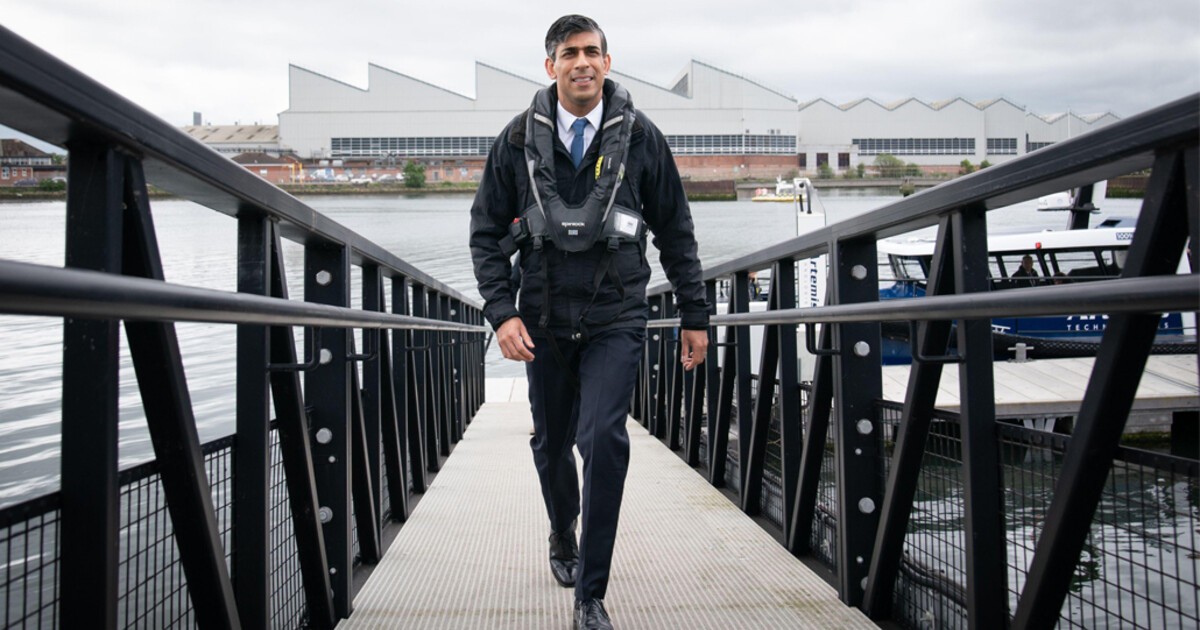
Rishi Sunak visiting the Titanic Quarter in Belfast, 24 May 2024. Photo © Stefan Rousseau / PA Images / Alamy
Rishi Sunak kicked off the UK’s surprise general election last Thursday, standing unsheltered in torrential rain outside Number Ten. His sodden launch was only one of many puzzling choices in the first week of the campaign, including an inauspicious visit to the shipyards that built the *Titanic*. The timing and strategic wisdom of the election is a greater puzzle. At the start of the year, both May and October looked plausible: the first to coincide with the local elections, the second to allow for a fiscal event in the autumn, replete with bribes for core Tory voters. Sunak’s announcement that the general election will be held on 4 July seems to have caught almost everyone – party machine, politicians, press – by surprise.
It is difficult to explain Sunak’s choice. He can hardly have missed that the polling average puts the Tories twenty points behind Labour. Recent economic good news is abstract compared to the enduringly high cost of virtually everything. The prime minister is not a man overburdened with charisma. The Conservatives’ chief electoral strategist, Isaac Levido, has stressed the ‘enthusiasm gap’ for Labour. But it takes some elaborate self-deception to read that voters despise you more than they like the other guy and take it as good news. Sunak must know he is going to lose. Perhaps he just wants it all to be over.
The prime minister may have been eyeing the exit, but he may also have been motivated by internal party factors. Most of his MPs have been in near-open dissension with his leadership; the war of succession has already begun. A welter of bad news is also likely before the autumn: not only the long-delayed Grenfell Inquiry report, but a seasonal increase in small boats crossing the Channel and a series of court challenges over deportations to Rwanda. An intervention from the European Court would have created an unmanageable rift in the Conservative Party – and the electorate – over withdrawing from the European Convention on Human Rights.
There’s also the question of losing well or badly. A decent loss (retaining more than two hundred seats) will smooth Sunak’s transition to post-political life; a catastrophic loss (under 120) could shatter the party for a decade. Such ‘policy’ announcements as the ill-defined National Service programme seem designed to stem the vote haemorrhage to Reform and appeal to the Tories’ ageing core voters (though only men over the age of 84, about 1 per cent of the population, are old enough to have done National Service themselves). A major difficulty, for Labour as well as the Tories, is a growing scepticism among voters that politicians in power can or will do any of the things they promise.
A raft of prominent Tories have already abandoned ship, depriving viewers of televisual schadenfreude on the evening of 4 July. The most significant is Michael Gove, whose successor in Surrey Heath is likely to be run close by the Liberal Democrats. But Gove is (by political standards) young, and thinks strategically. It may be that he believes he can have more influence over the future of Conservatism by returning to the pages of the *Times* to promote his ideology – at its core still the armed, paranoid neoconservatism of the 2000s – and his preferred candidates. It is unlikely to be a quiet retirement. Liz Truss remains obdurate. Her recent appearance on the ultra-reactionary conspiracy theory podcast ‘Lotus Eaters’ – which proffers a sub-Spenglerian inquiry into the ‘rot eating into the heart of the modern world’ – previews just one of the possible circuits of madness awaiting a post-Sunak party in opposition.
It is a surprise election with little surprising about it so far. The impromptu lift-off has left Labour scrabbling to land its messages and complete a bout of bloodletting and proscription before the candidacy deadlines close on 7 June. It has unveiled its first slogan, combining the vacuous and the Orwellian in ‘Stability is Change’. Yet the final result is not really in doubt: in a few weeks, Keir Starmer will be prime minister. Much of Labour’s unseemly activity in the past week has been guided by the expectation of victory: candidacies imposed for reasons of patronage and reward, or to rid the parliamentary party of lingering dissenters and provide Starmer with a frictionless debut in government.
Labour’s National Executive Committee has extensive powers to impose or alter candidacies in an election. It is not unusual for the party’s leadership to try to influence selections, or to strike deals with retiring MPs to replace them with favoured candidates. (Blair came to regret some of these, which elevated a parade of mediocrities to the Lords.) Starmer’s stitch-ups, though, have gone further than his predecessors’, removing prominent left-wingers in murky and underhand processes, and replacing them with favoured apparatchiks from Blairite pressure groups and the old Labour right – many of whom sit on the NEC. Two of the three panellists on Faiza Shaheen’s rushed NEC hearing have subsequently been handed candidacies. Her removal as the candidate for Chingford, along with the mishandling of Diane Abbott’s candidacy in Hackney – after Labour sources told the *Times* on Monday that she would be barred from standing, she is now, Starmer says, ‘free to stand’ after all – have stoked suspicions that minority candidates get treated differently by the boys’ club of enforcers around Starmer. Both cases seem marked by an appetite not only for factional victory but outright cruelty.
The enforcers don’t think this matters. Even if such behaviour ate a point or two from the lead, it would be worth it to produce a docile and compliant party. They are right that it is unlikely to shift many votes. But questions of character and fair dealing can linger in voters’ perceptions of politicians. Starmer insists he wants candidates of the ‘highest quality’, although the relative merits of lifelong bag-carriers and lobbyist drones are hard to discern when set against Shaheen’s trajectory from poor roots to real academic and professional achievement, and her obvious commitment to the area in which she grew up. The question nobody has yet asked Starmer concerns his frequent references to the way his toolmaker father was treated: last year he told the *Guardian* the quality he most deplores in others is disrespect. Does he think his party has treated either Abbott or Shaheen with respect?
The purge of the left cements Starmer’s dependence on his two key strategists, Morgan McSweeney and Matt Pound. The sometimes protean nature of the early Starmer period has calcified. His government is likely to share the vices of previous Labour governments: a strong conformism, interpreting disagreement as disloyalty, and a corresponding distaste for scrutiny. The eruption of the Abbott case seems to have been caused by elements on the party’s right being unable to resist triumphalist briefing about blocking her candidacy. It’s hard to see the appetite for intrigue and factionalism disappearing in government, especially when the Starmer project encounters real turbulence. It is less than wise to elevate inveterate plotters merely because they currently support you. Gratitude does not last long in politics.
The Labour left, meanwhile, cuts something of a sad figure. Its silence over the stitch-ups, motivated by self-preservation, has something of the grave about it. It must regret the failure to democratise selections and clip the NEC’s wings under Corbyn. Its strategic options are few, even though the progressive vote is likely to be strong in July. Left-wing unions have made a fuss about Labour’s ebbing commitment to its New Deal for Working People, though they may not have the strength to impose their will during the manifesto negotiations. They would be wise not to take vague commitments seriously. A strong mix of sentimentality and hard-headedness about Britain’s electoral system keeps left-wing politicians wedded to a leadership that despises them in a party without real means of internal leverage. Even defenestrated MPs make ritual obeisance to the leadership. The statements read like revenant Bukharin: there is something great and bold about the political idea of a general purge. Vote Labour.
What people will be voting for is less clear. Some MPs are already concerned that Labour’s messages are being lost amid the selection drama. It doesn’t help that the messages are vague. As the drama recedes, more important questions are bound to arise: are the commitments on energy merely rebadged private finance initiatives, an opportunity for private companies to leech off the state? What are they actually going to do about social care, other than hand-wave about private sector capacity? Why has the commitment to housebuilding receded from the offer? Do they really think they can do any of this without spending more money? Isn’t their proposed ‘fiscal lock’ a set of self-defeating handcuffs? With such questions looming, perhaps the fog of selection drama will be welcome for a while yet.